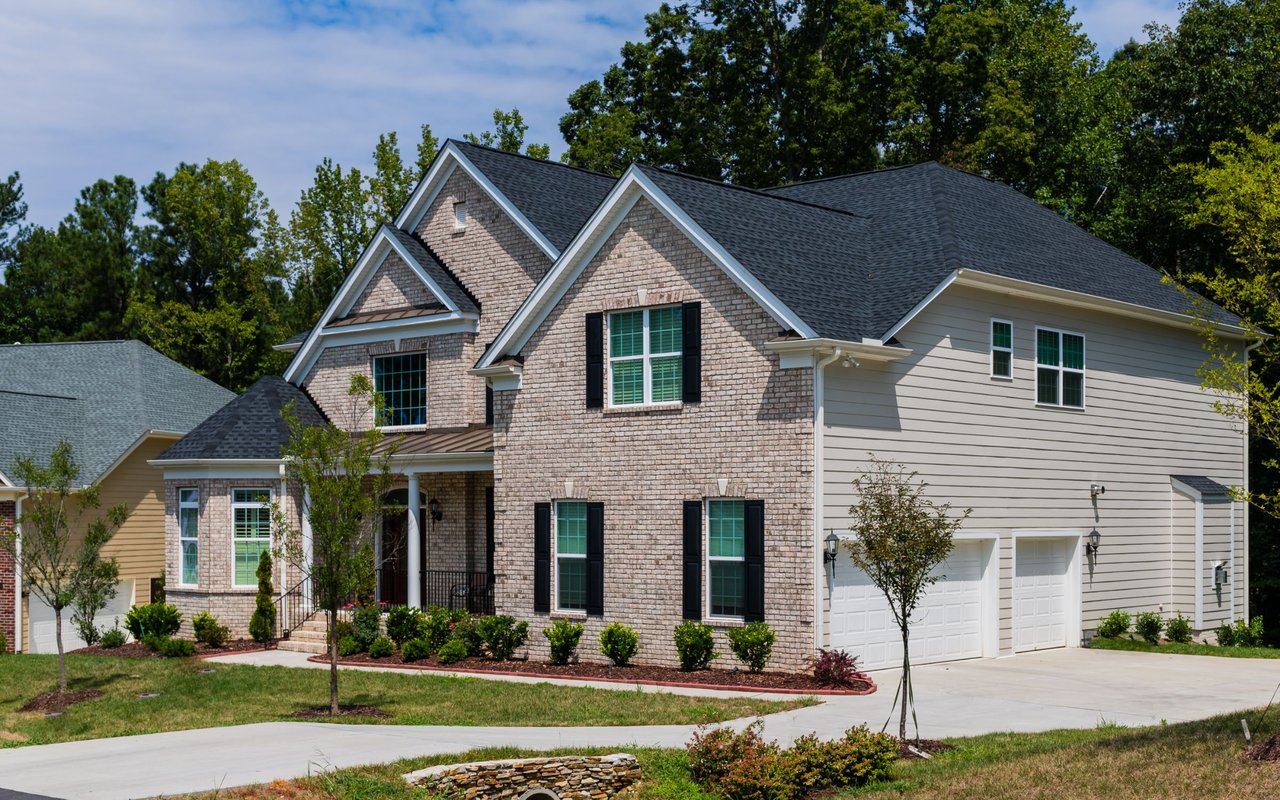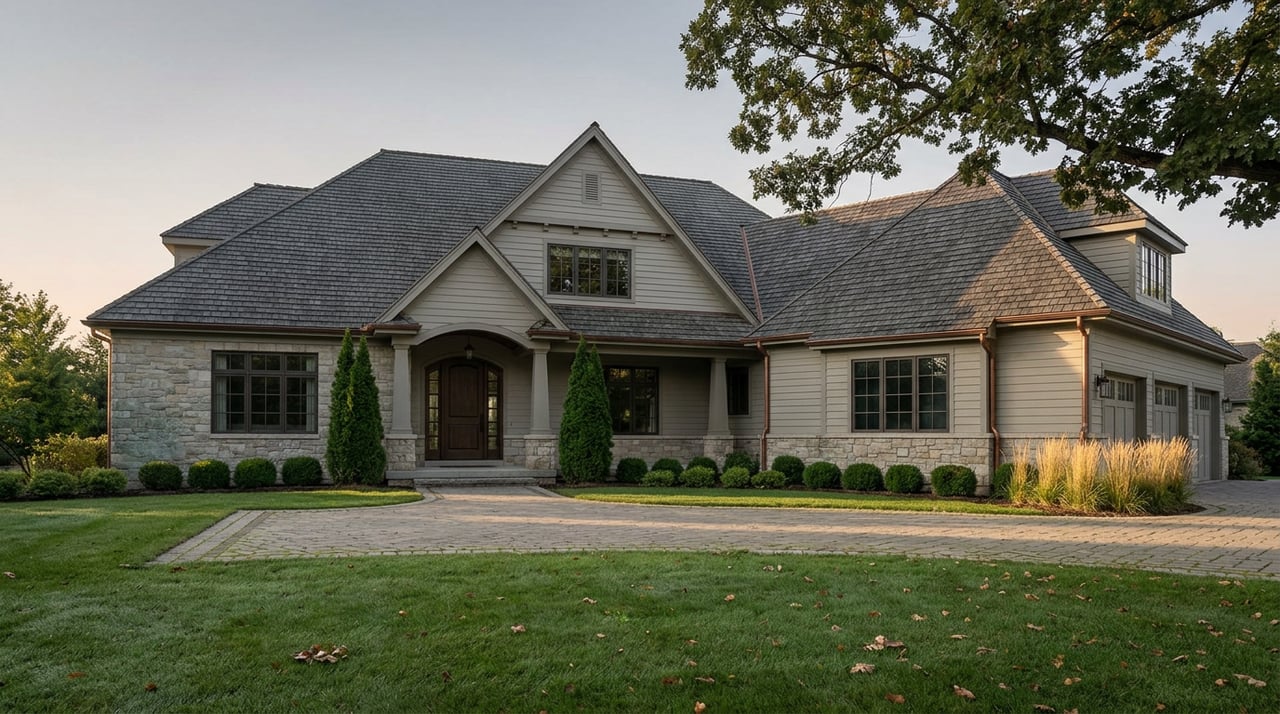
You're two weeks out from closing on a Lyon Township property when an email lands from your agent's office: schedule a septic evaluation before the transfer date. If you grew up somewhere with city water and city sewer, this is the first you're hearing that your future home has its own private wastewater system, and that Oakland County requires it to pass inspection before you can take title.
That moment catches a lot of buyers off guard, and it points to something the portals don't show you. Search "South Lyon homes for sale" and you get one blended market: one median price, one set of filters, one zip code. But 48178 actually covers two places that operate on different infrastructure, different utility bills, and different closing requirements. Knowing which side of that line a listing sits on changes what you're actually buying, not just what you're paying.
One Zip Code, Two Different Deals
The City of South Lyon covers about 3.5 square miles. It has its own water plant, its own wastewater treatment facility, and a historic downtown grid where homes were built decades before anyone subdivided the farmland around them. Surrounding it on every side is Lyon Charter Township, where the last twenty years brought large-scale subdivisions with names like Meadows of Lyon and Woods of Lyon, built out by Pulte and Lombardo with base prices that frequently start north of $500,000 before lot premiums and design center upgrades push the final number toward $650,000 or higher.
Here's the part that trips people up: both places share a mailing address and a zip code. A listing that says "South Lyon" could be a 1930s farmhouse on Lafayette Street inside city limits, or it could be new construction two miles away in a township subdivision with no connection to the city's utility system at all. The MLS won't flag that distinction for you. You have to know to ask.
| City of South Lyon | Lyon Township | |
|---|---|---|
| Water & sewer | Municipal, run by the city's own Water Department | Often private well and septic |
| Typical closing price, Aug. 2025 | Around $323,000 | Broader 48178 figure, township-inclusive, around $565,000 |
| Utility billing | Combined rate of $9.69 per 1,000 gallons plus quarterly Ready to Serve charges | Where public water exists, billed by the township at $18.06 per 1,000 cubic feet; private well parcels have no water bill at all |
| Septic inspection at sale | Not applicable for city-connected homes | Required by Oakland County if the property has an on-site system |
What the Blended Median Actually Hides
When you see a single average home value for "South Lyon" on a real estate site, you're looking at a number that averages together two products that don't really compete with each other. Recent closing data broke it out more clearly: homes closing within the City of South Lyon proper sold near $323,000 in August 2025, while the wider 48178 ZIP, which folds in Lyon Township's larger new-construction inventory, landed closer to $565,000 for the same month.
That is not a modest spread. It is the difference between a walkable bungalow on a quarter-acre in-town lot and a four-bedroom Colonial on a half-acre in a subdivision still selling floor plans. Both carry the same zip code. Neither one tells you much about the other. If you've been anchoring your search around a single "South Lyon average," you've been comparing two different housing stocks as if they were one.
The practical takeaway: ask whether a listing sits inside city limits or in the township before you use any published average as your baseline. The number changes meaning depending on which side of that line you're standing on.
The Inspection Nobody Mentions Until It's Due
Michigan has no statewide septic code. Every county writes its own rules, and Oakland County, where Lyon Township sits, requires a time-of-transfer evaluation through its Health Division before a property with an on-site septic system can change hands. That inspection typically runs $400 to $800 and includes a tank pump and a drainfield assessment, according to the county's own guidance.
If the system passes, it's a line item and a delay of a few days. If it fails, the math gets bigger fast. A conventional system replacement runs $7,000 to $15,000 installed. But parts of Oakland County sit on high water tables, and where the drainfield can't get enough separation from groundwater, the fix is a raised mound system instead, which runs $15,000 to $25,000. That's a repair cost that can show up in the final week of a transaction, on a property you may have already fallen in love with.
This only applies to homes with private septic, which in practice means most of the properties in this market carrying that risk sit in the township rather than the city core. If you're comparing a city listing to a township listing on price alone, you're leaving out a cost category that only exists on one side of the comparison.
Where the Water Bill Becomes a Water System
Inside city limits, water and sewer are utilities you pay for by usage. The City of South Lyon runs its own water plant, drawing from three wells between 120 and 125 feet deep, and its wastewater treatment facility on Dixboro Road discharges into Yerkes Drain, which flows west toward the Huron River. Residents get a quarterly bill: a combined rate of $9.69 per 1,000 gallons, per the city's rate schedule effective December 2025, plus Ready to Serve charges of $9.74 for water and $17.87 for sewer.
Cross into the township, and for a lot of parcels, water and sewer stop being a bill and start being a system you own. Where Lyon Township does bill for public water, a 2025 township rate notice put usage at $18.06 per 1,000 cubic feet plus meter charges, a different structure entirely from the city's per-gallon billing. For parcels on a private well, there's no water bill at all, just the electricity to run the pump, periodic water testing, filter cartridges, and softener salt. Regional groundwater in this part of Oakland County also runs hard, with calcium, magnesium, and iron common enough that most well-fed homes end up running a softener or filtration system just to keep fixtures from staining. None of that shows up in a mortgage calculator, but it's a real monthly cost difference between the two sides of this market.
The Tax Line Moves Too
Property tax in Michigan runs on millage, and it shifts depending on both location and how the property is used. Non-homestead properties, meaning most rental and investment purchases, pay roughly 18 mills more than an owner-occupied home in the same area. On top of that, Lyon Township tends to carry a lower overall millage than the city, which layers on its own rate for municipal services the township doesn't provide directly.
For a buyer comparing an investment property in the township to one inside city limits, that combination, lower base millage plus no additional city layer, can add up to real monthly savings on carrying costs. It's a detail worth running by whoever handles your specific parcel's tax history before you write an offer, because the difference compounds over a hold period.
A Few Straight Answers
How do I know if a specific address is city or township? Ask directly. City limits and township boundaries don't always line up with how people talk about the area, and two homes a few blocks apart can fall on opposite sides of the line.
Does every Lyon Township home rely on well and septic? No. Some parcels connect to public water. But private well and septic is common enough in the township that you should confirm it for any specific listing rather than assume either way.
What happens if the septic inspection turns up a problem close to closing? Buyers and sellers sometimes negotiate a price adjustment to cover repairs, or the buyer takes on the fix after closing with it documented in writing. Either way, it's a conversation worth having as early in the process as possible, not during the final week.
If you're weighing a South Lyon listing against one across the line in the township, or you're an investor trying to model carrying costs before you make an offer, that's exactly the kind of local detail worth a phone call before it's a surprise at the closing table. The team at Realtors Bob and Mike works this market block by block, city limit and township line included, and can walk you through what a specific address actually means for your utility bill, your tax rate, and your inspection checklist. Get your instant home valuation and let's talk through the details that matter for your specific parcel.